
Paris does not need an introduction — and yet every visit feels like meeting it for the first time. From the gilded halls of Versailles to a table at a zinc-countered bistro in the 11th arrondissement, here is your definitive guide to the French capital.
The Eiffel Tower, completed in 1889 for the World’s Fair, remains the undisputed symbol of Paris and one of the most visited monuments on earth.
TG
Travel Guide EditorialUpdated April 2026 · Expert-reviewed · 14 min read
There is a reason Paris has been called the most beautiful city in the world for three hundred years — and that reason is not the Eiffel Tower, or the Louvre, or the croissants, though all three are justifications enough. It is the sum of Paris that overwhelms: the way the light falls on Haussmann’s limestone façades at six in the evening, the way a café table on a narrow street in the Marais can feel like the still centre of the universe, the way the city makes even grocery shopping feel like an aesthetic event.
Paris is also, let it be said, a demanding city. It rewards preparation, rewards curiosity, and punishes passivity. Visitors who plan thoughtfully — who know which museum to book weeks in advance, which neighbourhood to stay in, which arrondissements to explore on foot — leave transformed. Those who arrive without a plan often spend three days in queues at the Louvre and leave having missed the best of it. This guide is designed to make sure you are in the first category.
🌡️
Best seasonApr–Jun · Sep–Oct
💱
CurrencyEuro (EUR)
🗣️
LanguageFrench
✈️
Main airportCDG · 30 min by RER B
🏨
Neighbourhoods20 arrondissements
The Eiffel Tower & the Iconic Landmarks
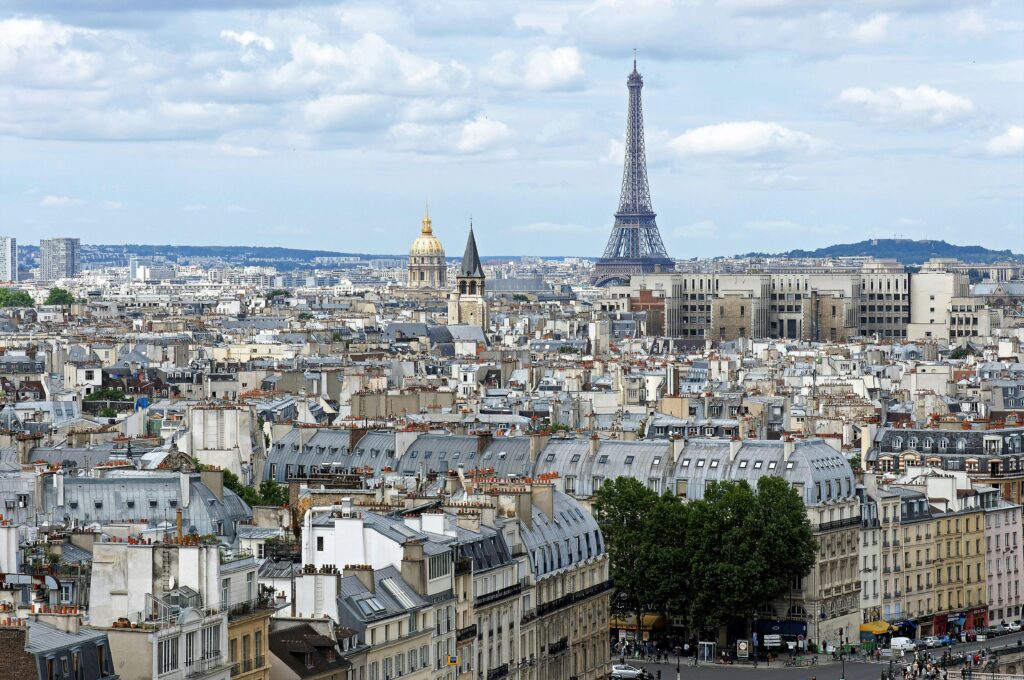
No visitor to Paris should skip the Eiffel Tower — but the way most visitors experience it is almost always wrong. The queues for the lift to the summit can stretch to two hours in high season; booking timed-entry tickets online at least three weeks in advance is not optional, it is essential. The second floor offers arguably the best view — intimate enough to read the city’s layout, high enough to feel genuinely suspended above it. The summit, on a clear day, reveals the entire Île-de-France basin out to 70 kilometres.
The Tower itself is best seen at night, when it sparkles for five minutes at the top of every hour. The best viewpoints are the Trocadéro esplanade directly across the Seine, or — for a quieter, more cinematic angle — the Champ de Mars gardens to the south, from which the whole structure rises like a mathematical hallucination above the lawn.
Beyond the tower, the list of truly unmissable Parisian monuments is long but navigable: Notre-Dame de Paris, now magnificently restored after the 2019 fire and open again to visitors, is one of the supreme achievements of Gothic architecture. Sainte-Chapelle, on the Île de la Cité, contains fifteen stained-glass windows of staggering beauty that most tourists skip entirely. The Arc de Triomphe, standing at the apex of the Champs-Élysées, offers a rooftop panorama that is often overlooked in favour of the Eiffel Tower — and is significantly easier to access.
Insider tipNotre-Dame reopened in December 2024 after five years of restoration. The interior has been entirely renewed and is now more luminous than it has been in centuries. Book timed-entry tickets online — it is free, but capacity is controlled.
The Louvre & the Paris Museum Circuit
The Louvre is the largest art museum in the world, and it is entirely possible to spend a week there and still feel you have missed things — because you have. A single visit requires ruthless prioritisation. The must-sees are the Mona Lisa (smaller and more crowded than you expect), the Winged Victory of Samothrace (larger and more spectacular than you expect), and the Venus de Milo. Beyond those, choose a single wing or civilisation and go deep rather than trying to cover everything.
Paris’s museum ecosystem extends far beyond the Louvre, however, and several institutions rival or surpass it for specific interests. The Musée d’Orsay, housed in a converted Belle Époque railway station on the Left Bank, holds the world’s finest collection of Impressionist painting — Monet, Renoir, Degas, Van Gogh, Cézanne — in a space that is itself a masterpiece. The Centre Pompidou in the Marais is the premier venue for modern and contemporary art in Europe. And the Musée de l’Orangerie, in the Tuileries gardens, contains Monet’s vast Nymphéas water lily murals in two oval rooms designed by the artist himself — an experience that is closer to meditation than museum-going.
Paris is always a good idea — and a great idea if you know where to look.
The Best Things to Do in Paris
- 01Walk the Seine at dawn. The riverbanks — classified as a UNESCO World Heritage Site — are at their most beautiful in the early morning, before the tourist boats begin. Cross the Pont des Arts, cross the Pont Neuf, and watch the city wake up from the water’s edge.
- 02Spend a morning in the Marais. The 3rd and 4th arrondissements contain Paris’s most beautiful Renaissance architecture, its vibrant Jewish quarter, the Place des Vosges (the city’s oldest planned square), and some of its best contemporary galleries and boutiques.
- 03Climb to Montmartre at sunset. The hilltop village above the 18th arrondissement — crowned by the white Sacré-Cœur Basilica — offers a panoramic view of the entire city. Come for the view, stay for the village atmosphere of the Place du Tertre.
- 04Take a day trip to Versailles. The Palace of Versailles, 40 minutes from central Paris by RER C, is one of the greatest exercises in royal extravagance ever built. The Hall of Mirrors and the Grand Canal gardens are unmissable. Book well in advance.
- 05Explore the Père Lachaise cemetery. Paris’s largest cemetery is also one of its most atmospheric public spaces — a wooded hillside city of the dead where Chopin, Proust, Oscar Wilde, Édith Piaf, and Jim Morrison are buried. Allow two hours.
- 06Visit the Palais Royal gardens. One of central Paris’s best-kept secrets — a colonnaded royal garden with a perfectly restored 18th-century arcade, independent boutiques, and Daniel Buren’s controversial striped columns. Peaceful even in high season.
- 07Descend into the Catacombs. Six million human remains line the underground tunnels beneath the 14th arrondissement. Macabre, genuinely moving, and historically fascinating — a Paris entirely invisible from the surface. Book timed-entry tickets online.
✦ ✦ ✦
Where to Stay: Paris by Neighbourhood
Paris’s twenty arrondissements spiral outward from the Île de la Cité like a snail’s shell, each with its own personality. Choosing where to stay is as important as choosing where to go — and the right neighbourhood will fundamentally shape your experience of the city.
Le Marais (3rd–4th)Historic · Vibrant · Central
The most walkable neighbourhood in Paris. Medieval streets, great cafés, strong LGBTQ+ scene, Jewish quarter, excellent museums. Ideal for first-time visitors.
Saint-Germain (6th)Literary · Elegant · Left Bank
Paris of Sartre and Hemingway, of Café de Flore and brasserie lunches. Refined, expensive, and impossible not to love. Close to the Orsay and Luxembourg Gardens.
Montmartre (18th)Bohemian · Scenic · Atmospheric
Steep stairs, artists’ studios, village squares, and one of the great city views in Europe. Slightly removed from central attractions but enchanting to come home to.
Bastille (11th–12th)Local · Lively · Affordable
Where actual Parisians eat, drink, and live. Excellent market street (Marché d’Aligre), great natural wine bars, better value than the more central arrondissements.
Invalides (7th)Quiet · Prestigious · Museums
Home to the Musée d’Orsay, Rodin Museum, and Napoleon’s tomb. Hushed, aristocratic, and beautifully preserved. Perfect for museum-focused itineraries.
Canal Saint-Martin (10th)Trendy · Young · Authentic
Leafy iron footbridges, indie coffee shops, and the most credible restaurant scene in the city. The Paris that Parisians under 35 actually inhabit.
What to Eat: A Parisian Food Education
Eating well in Paris is both easier and harder than it looks. Easier, because even a mediocre Parisian boulangerie produces croissants that would be the best thing on offer in most cities. Harder, because the city also contains hundreds of tourist-trap restaurants — particularly around Notre-Dame, the Champs-Élysées, and Montmartre’s Place du Tertre — that charge Parisian prices for cooking that would embarrass a provincial motorway service station. The rule of thumb is simple: if a restaurant has a laminated menu with photographs, keep walking.
🥐Croissants & viennoiserie. The morning ritual. Look for the word artisan boulanger on the shop front, and always choose butter croissants (straight) over margarine (curved). The best in the city change every year — ask your hotel, ask a local, ask anyone.
🥩Steak-frites & bistro classics. A well-executed entrecôte with sauce béarnaise and a glass of Côtes du Rhône at a properly run zinc-countered bistro is one of the great dining experiences in the world. Lunch menus (the formule) at top bistros offer three courses for 15–25€ — the best value in Paris.
🧀Cheese & charcuterie. Every fromagerie is a museum. Ask the cheesemonger for regional recommendations and always buy cheese at room temperature. A proper plateau de fromages — six or seven cheeses at various stages of ripeness — is an essential Parisian experience.
☕Coffee culture. The classic Parisian café au comptoir — an espresso stood at the zinc bar — is a ritual as much as a drink. The city’s specialty coffee scene (Belleville Brûlerie, Telescope, Ten Belles) now rivals any in Europe for those who want it.
🍷Wine & natural wine bars. Paris’s wine bar scene has been transformed in the past decade by a generation of small producers and passionate sommeliers. Le Verre Volé, Septime Cave, and Le Baron Rouge (bring your own bottle on Sunday mornings) are institutions.
Practical tipAlways say bonjour when entering a shop or restaurant and au revoir when leaving. This one habit will improve every interaction you have in Paris. Parisians are not unfriendly — they simply observe a code of civility that many tourists accidentally skip.
When to Visit Paris
BestSpring15–22°CCherry blossom, outdoor terraces, the city at its most alive.
Summer25–33°CPeak crowds, long days, Bastille Day (July 14). Book everything far ahead.
BestAutumn12–20°CGolden light, fewer queues, fashion week, harvest menus.
Winter4–10°CChristmas markets, museum season, low prices — but be prepared for rain.
Getting Around Paris
Paris has one of the finest urban public transport networks in the world, and using it is both cheaper and faster than taxis for most journeys. The Métro covers virtually every corner of the city with sixteen lines and runs until 1 AM on weekdays (2 AM on weekends). A carnet of ten single tickets — or the Navigo Easy contactless card, which allows unlimited loading — represents the best value for most visitors staying more than two days.
For sightseeing, however, the best transport in Paris is your feet. The city’s historic centre is compact: it takes roughly 45 minutes to walk from Notre-Dame to the Eiffel Tower, passing through the Saint-Germain quarter, the Luxembourg Gardens, and the beginning of the 7th arrondissement. A significant proportion of what makes Paris beautiful is only visible at walking pace. Allow time to get lost — and to find things that appear on no map.
Getting from the airportFrom Charles de Gaulle (CDG): the RER B train takes 35 minutes to central Paris and costs around €11.80 — by far the best option. Taxis are metered and cost a fixed rate of €56 to the Right Bank and €65 to the Left Bank. Avoid unofficial taxi touts at arrivals. From Orly (ORY): the Orlyval shuttle connects to the RER B. Journey time to central Paris is approximately 35 minutes.
Practical Tips for Every Paris Visitor
A few essentials that will make a measurable difference to your time in Paris. Book major attractions online — the Louvre, Eiffel Tower, Versailles, Catacombs, and Sainte-Chapelle all have timed-entry systems that allow you to bypass queues entirely. Arriving without pre-booked tickets at any of these in peak season is a significant waste of time. Carry cash — Paris is increasingly card-friendly, but smaller boulangeries, market stalls, and neighbourhood cafés still prefer it. Learn basic French — a handful of phrases goes further than in almost any other country in the world. And keep Sundays free for wandering — many shops close, but the city acquires a contemplative beauty that belongs only to that day.
Paris rewards the visitor who slows down. It is a city made for lingering — over a second coffee, over a bookshop window, over a bridge at dusk. The itinerary matters far less than the disposition you bring to it. Come with patience, come with appetite, and come prepared to let the city rearrange your expectations of what a city can be.