
From the intoxicating labyrinth of the medina to the rose-scented valleys beyond the Atlas Mountains, Marrakech is unlike any city on earth. Here is your complete guide to experiencing it fully.
Travel Guide EditorialUpdated April 2026 · 12 min read

Jemaa el-Fna square at dusk — Marrakech, Morocco
Jemaa el-Fna, UNESCO-listed as an Intangible Cultural Heritage of Humanity, transforms from a daytime market into a spectacular open-air theatre each evening.
Few cities arrive with as much advance reputation as Marrakech. The so-called Red City — named for its rose-hued sandstone walls — has been seducing travellers for centuries. Located at the foot of the High Atlas Mountains in southwest Morocco, it sits at the crossroads of Africa, the Arab world, and Berber culture, and that collision of influences makes it one of the most visually, gastronomically, and spiritually rich destinations on the planet.
Whether you are planning your first visit or returning to dive deeper, this complete Marrakech travel guide covers everything: the best things to do, where to stay, what to eat, when to go, and how to navigate one of the world’s great medinas without losing your mind — or your wallet.
Best season
Mar–May · Sep–Nov
💱
Currency
Moroccan Dirham (MAD)
🗣️
Languages
Darija · French · Tamazight
✈️
Airport
RAK — 6 km from medina
Jemaa el-Fna: The Soul of Marrakech
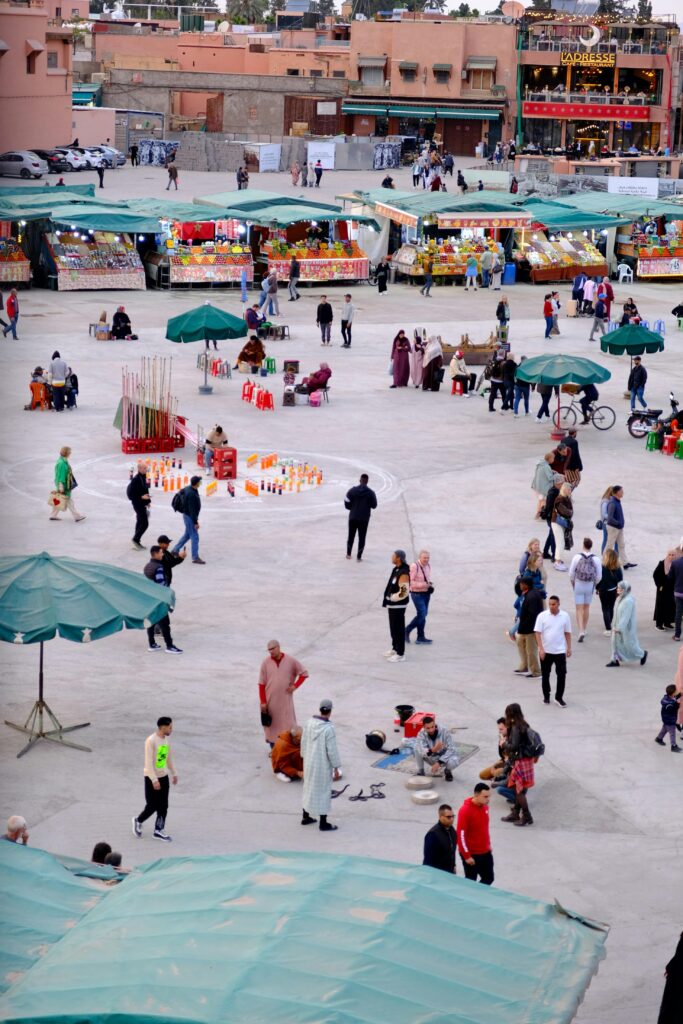
No journey to Marrakech is complete without spending time at Jemaa el-Fna, the city’s legendary central square. By day, it is an open-air market filled with orange juice vendors, henna artists, snake charmers, and the occasional trained monkey. By night, it transforms into something almost otherworldly — dozens of makeshift restaurants materialise in clouds of charcoal smoke, storytellers hold crowds rapt in Darija, and the Atlas foothills disappear behind a veil of electric light.
Listed by UNESCO as an Intangible Cultural Heritage of Humanity, the square is less a tourist attraction than a living organism. Locals argue, merchants negotiate, and musicians play gnawa rhythms that seem to vibrate through the pavement. The best strategy is to let yourself get lost in it. Climb to a rooftop terrace café on the square’s perimeter — a mint tea in hand — and watch it unfold from above before descending to participate in the chaos below.
Insider tipArrive at Jemaa el-Fna at sunset (around 7 PM in summer, 5:30 PM in winter). The hour when the market stalls light up and the evening performers take over is the most photogenic and atmospheric moment of the entire day.
The Medina: Navigating the Labyrinth
The medina of Marrakech — its ancient walled city — is a UNESCO World Heritage Site and one of the largest car-free urban areas in the world. Its roughly 18 km of narrow, winding alleyways, called derbs, form a maze that has confused and enchanted visitors for a thousand years. You will get lost. Accept it. Getting lost is the point.
The medina is divided into distinct quarters, each with its own character. The Mouassine quarter, northwest of Jemaa el-Fna, is home to some of the city’s most elegant riads (traditional Moroccan guesthouses built around a central courtyard). The Mellah, the old Jewish quarter to the east, offers a quieter, more contemplative atmosphere. And the Souk district, sprawling north of the square, is where commerce has been conducted for centuries.
The souks are organised loosely by trade — the dyers’ souk (Souk Sebbaghine), the spice souk, the leather workers’ quarter around the famous Chouara tannery — though the boundaries blur delightfully. Navigation apps work surprisingly well inside the medina, but the best exploration happens when you put your phone away.
Top Things to Do in Marrakech
- 1Bahia Palace — A 19th-century palace of staggering opulence, with intricately carved cedarwood ceilings, hand-painted tilework, and tranquil orange-blossom gardens. Arrive early to beat the crowds.
- 2Saadian Tombs — Discovered only in 1917, these royal mausoleums date to the late 16th century and represent some of the finest Moroccan craftsmanship in existence.
- 3Jardin Majorelle — Designed by French painter Jacques Majorelle and later restored by Yves Saint Laurent, this cobalt-blue garden is a rare oasis of calm. Book tickets in advance — queues are long.
- 4Medersa Ben Youssef — The largest medieval Quranic school in North Africa, this 16th-century madrasa features breathtaking zellige tilework and carved stucco. A masterpiece of Islamic architecture.
- 5Day trip to the Atlas Mountains — The foothills begin just 30 minutes from the city. The village of Imlil offers hiking, mule rides, and lunch with Berber families in the Aït Benhaddou valley.
Marrakech does not let you be a passive observer. It requires your full presence — your senses, your patience, and your willingness to be surprised.
Where to Eat: Marrakech’s Food Scene
Moroccan cuisine is one of the great culinary traditions of the world, and Marrakech is its best showcase. The city’s food landscape ranges from street stalls serving one-dirham msemen (flaky flatbread) to Michelin-standard restaurants in candlelit riads.
Start any morning with bessara — a thick fava bean soup drizzled with olive oil and cumin, served with crusty bread — from one of the stalls near the Bab Doukkala gate. For lunch, head to the food stalls at Jemaa el-Fna: number each stall clearly, and the grilled lamb chops, kefta, and snails are consistently excellent and cheap. In the evenings, seek out a proper sit-down meal: a pastilla (a sweet-savoury pigeon or chicken pie dusted with icing sugar) followed by a slow-braised lamb tagine with preserved lemon and olives is the classic Marrakchi sequence.
What to drinkMorocco is a Muslim country where alcohol is not consumed openly. In most local cafés and restaurants, you will find only non-alcoholic options — but mint tea, café cassé (coffee cut with warm milk), and fresh-squeezed orange juice from Jemaa el-Fna are all exceptional. Several boutique hotels and licensed restaurants do serve wine.
When to Visit Marrakech
The best times to visit Marrakech are spring (March to May) and autumn (September to November), when temperatures are warm but not brutal — typically between 20°C and 30°C. The city is vibrantly alive, the rose gardens of the Dades Valley are in bloom in April, and the light has a quality that photographers dream about.
Summer (June to August) brings intense heat, regularly exceeding 40°C, which makes afternoon sightseeing challenging. That said, accommodation prices drop significantly, and the medina takes on a quieter, more local character. Winter (December to February) is cool — sometimes cold at night — and occasionally rainy, but the Atlas Mountains are snow-capped and spectacular.
Where to Stay: Riads vs. Hotels
Staying in a riad — a traditional Moroccan house built inward around a courtyard — is one of the defining experiences of a Marrakech visit. From the outside, riads reveal nothing; step through a nondescript wooden door in a narrow alley and you find yourself in a tiled paradise of fountains, orange trees, and handwoven textiles. Most riads in the medina offer between four and twenty rooms, service is intensely personal, and the rooftop terraces are invariably spectacular.
For those who prefer international hotel standards, the Guéliz neighbourhood (the ville nouvelle, or new city, built during the French protectorate) offers larger properties with pools, gyms, and reliably consistent comfort. It is also quieter and easier to navigate, with good restaurants and boutiques along Avenue Mohammed V.
Practical Tips for First-Time Visitors
Bargaining is expected in the souks — start at roughly a third of the asking price and meet somewhere in the middle. Never feel pressured; the right to walk away is always yours. Dress modestly in the medina: covered shoulders and knees show respect and you will be treated noticeably better. Carry small change: many vendors and guides prefer cash, and exact coins avoid awkward negotiations. Finally, a few words of French or Arabic — shukran (thank you), la shukran (no thank you) — go a long way.
Getting aroundTaxis are cheap and widely available. Always agree on a price before getting in, or insist on the meter. The medina itself is pedestrian only — even bicycles are officially restricted in many areas. From the airport, a petit taxi should cost no more than 80–100 MAD to the medina.
Marrakech is not a city that yields its secrets quickly. It rewards patience, curiosity, and a willingness to follow your nose — literally and metaphorically — into unknown territory. Come with an open itinerary, a spirit of inquiry, and the understanding that the best thing you will see all day might be something that never appears in any guidebook.